
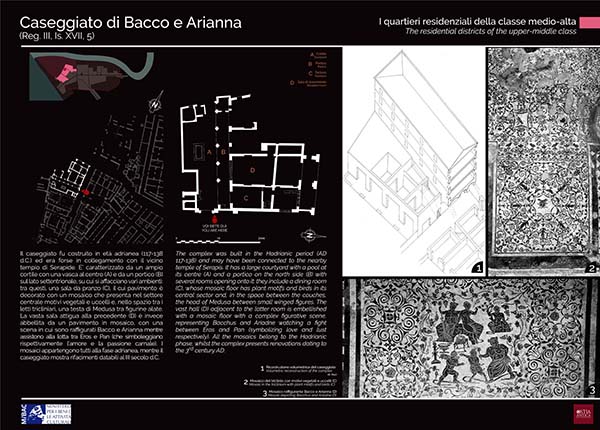
The complex was built in the Hadrianic period (AD 117-138) and may have been connected to the nearby temple of Serapis. It has a large courtyard with a pool at its centre (A) and a portico on the north side (B) with several rooms opening onto it: they include a dining room (C), whose mosaic...
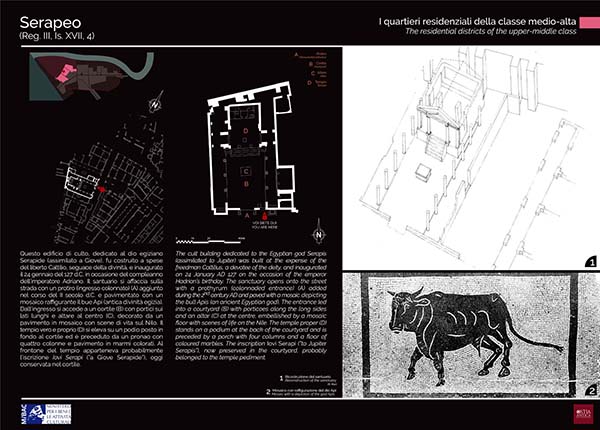
The cult building dedicated to the Egyptian god Serapis (assimilated to Jupiter) was built at the expense of the freedman Caltilius, a devotee of the deity, and inaugurated on 24 January AD 127 on the occasion of the emperor Hadrian’s birthday. The sanctuary opens onto the street with a...
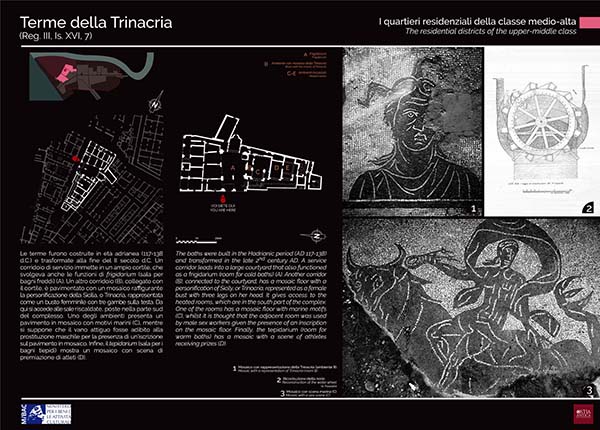
The baths were built in the Hadrianic period (AD 117-138) and transformed in the late 2nd century AD. A service corridor leads into a large courtyard that also functioned as a frigidarium (room for cold baths) (A). Another corridor (B), connected to the courtyard, has a mosaic floor...
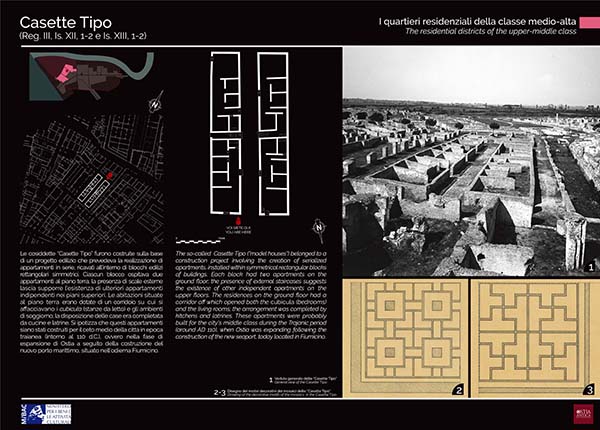
The so-called Casette Tipo (”model houses”) belonged to a construction project involving the creation of serialized apartments, installed within symmetrical rectangular blocks of buildings. Each block had two apartments on the ground floor; the presence of external staircases suggests the...
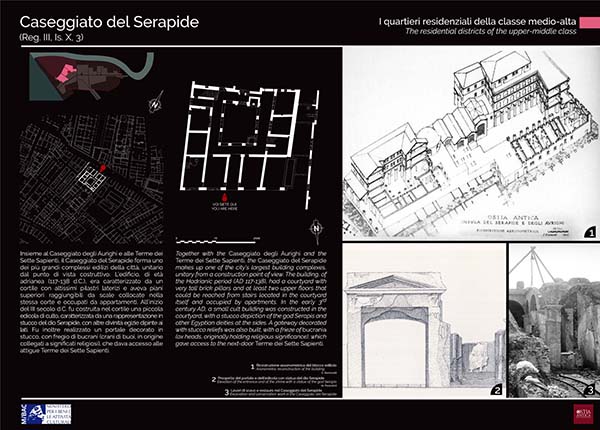
Together with the Caseggiato degli Aurighi and the Terme dei Sette Sapienti, the Caseggiato del Serapide makes up one of the city’s largest building complexes, unitary from a construction point of view. The building, of the Hadrianic period (AD 117-138), had a courtyard...
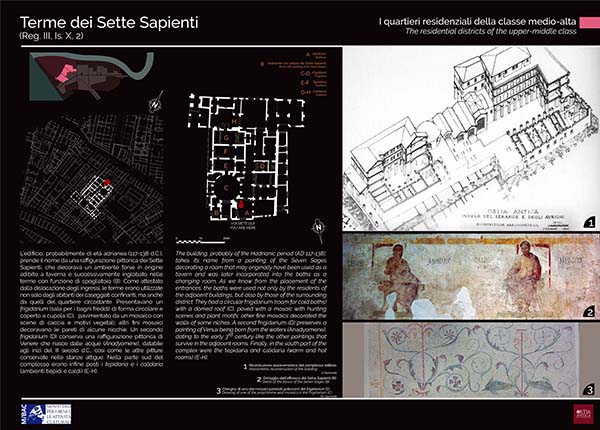
The building, probably of the Hadrianic period (AD 117-138), takes its name from a painting of the Seven Sages decorating a room that may originally have been used as a tavern and was later incorporated into the baths as a changing room. As we know from the placement of the entrances, the...
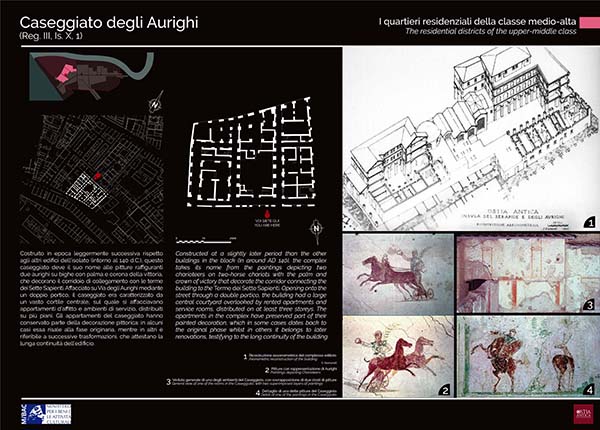
Constructed at a slightly later period than the other buildings in the block (in around AD 140), the complex takes its name from the paintings depicting two charioteers on two-horse chariots with the palm and crown of victory that decorate the corridor connecting the building to the Terme...
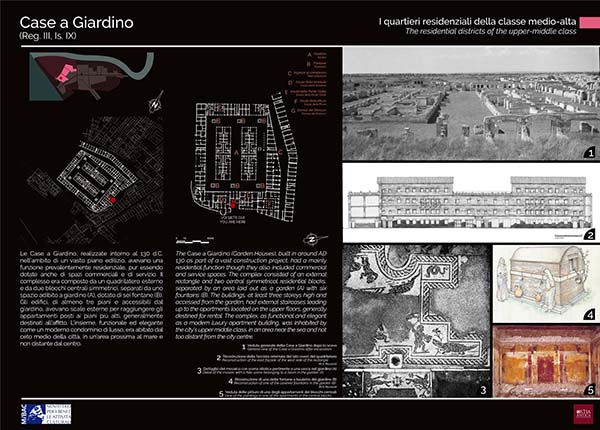
The Case a Giardino (Garden Houses), built in around AD 130 as part of a vast construction project, had a mainly residential function though they also included commercial and service spaces. The complex consisted of an external rectangle and two central symmetrical residential blocks,...
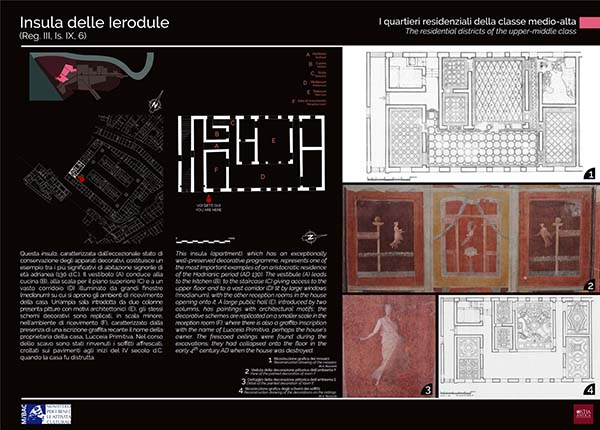
This insula (apartment), which has an exceptionally well-preserved decorative programme, represents one of the most important examples of an aristocratic residence of the Hadrianic period (AD 130). The vestibule (A) leads to the kitchen (B), to the staircase (C) giving access to the...
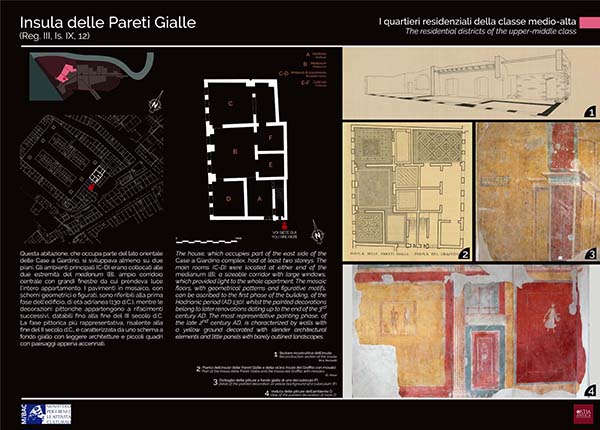
The house, which occupies part of the east side of the Case a Giardino complex, had at least two storeys. The main rooms (C-D) were located at either end of the medianum (B), a sizeable corridor with large windows, which provided light to the whole apartment. The mosaic floors,...
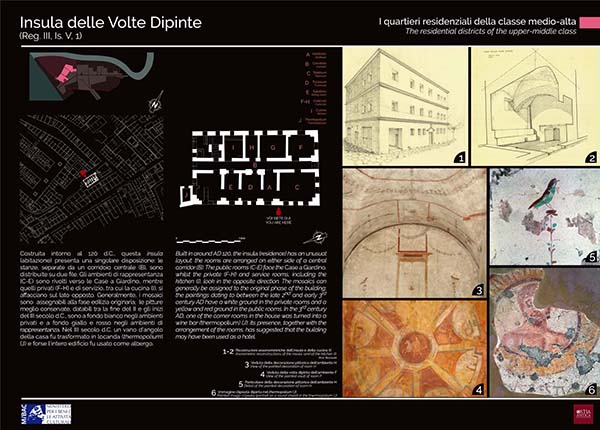
Built in around AD 120, the insula (residence) has an unusual layout: the rooms are arranged on either side of a central corridor (B). The public rooms (C-E) face the Case a Giardino, whilst the private (F-H) and service rooms, including the kitchen (I), look in the opposite...
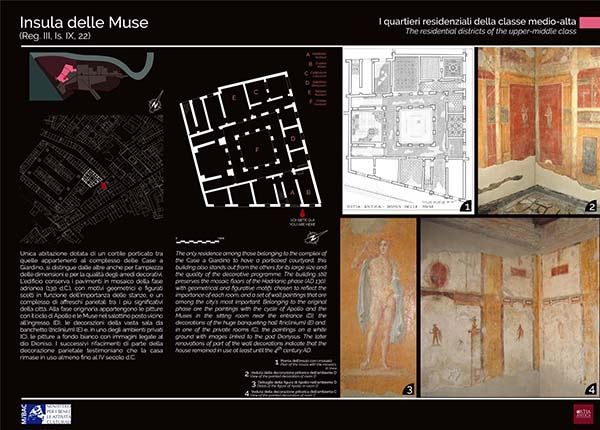
The only residence among those belonging to the complex of the Case a Giardino to have a porticoed courtyard, this building also stands out from the others for its large size and the quality of the decorative programme. The building still preserves the mosaic floors of the Hadrianic...
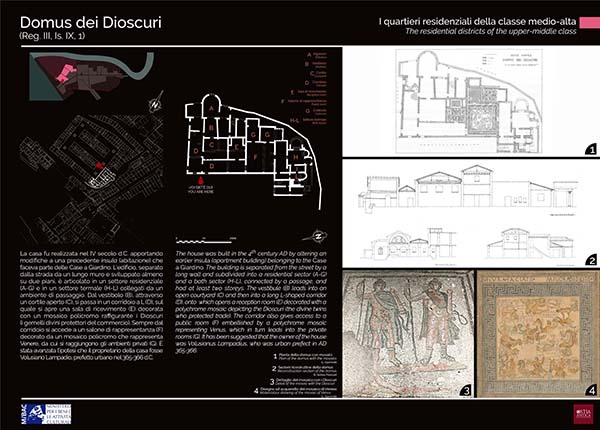
The house was built in the 4th century AD by altering an earlier insula (apartment building) belonging to the Case a Giardino. The building is separated from the street by a long wall and subdivided into a residential sector (A-G) and a bath sector (H-L), connected by a passage,...
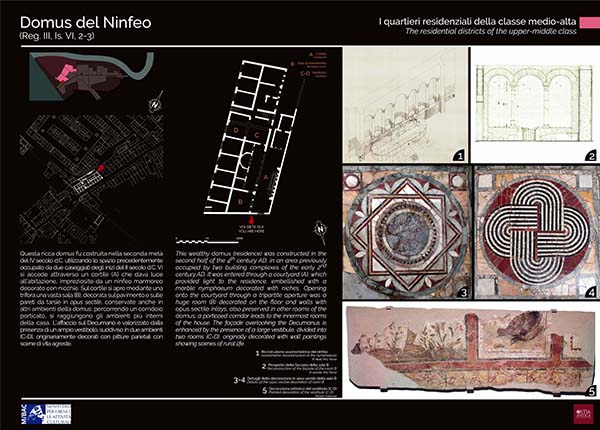
This wealthy domus (residence) was constructed in the second half of the 4th century AD, in an area previously occupied by two building complexes of the early 2nd century AD. It was entered through a courtyard (A), which provided light to the residence, embellished with a marble...
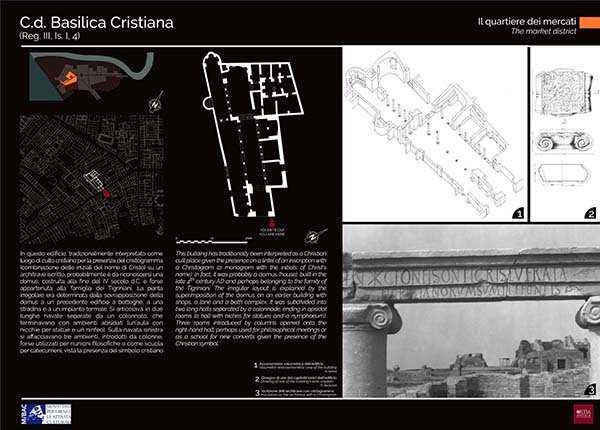
This building has traditionally been interpreted as a Christian cult place given the presence on a lintel of an inscription with a Christogram (a monogram with the initials of Christ’s name). In fact, it was probably a domus (house), built in the late 4th century AD and perhaps...
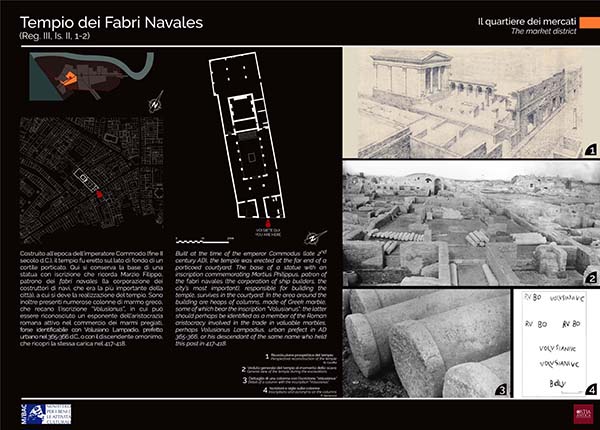
Built at the time of the emperor Commodus (late 2nd century AD), the temple was erected at the far end of a porticoed courtyard. The base of a statue with an inscription commemorating Martius Philippus, patron of the fabri navales (the corporation of ship builders, the city’s most...
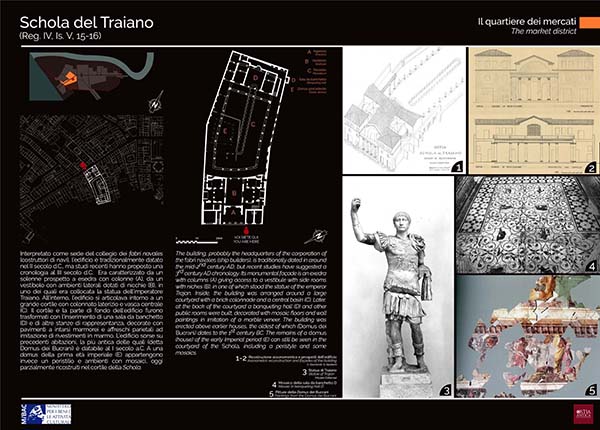
The building, probably the headquarters of the corporation of the fabri navales (ship builders), is traditionally dated in around the mid-2nd century AD, but recent studies have suggested a 3rd century AD chronology. Its monumental façade is an exedra with columns (A) giving access...
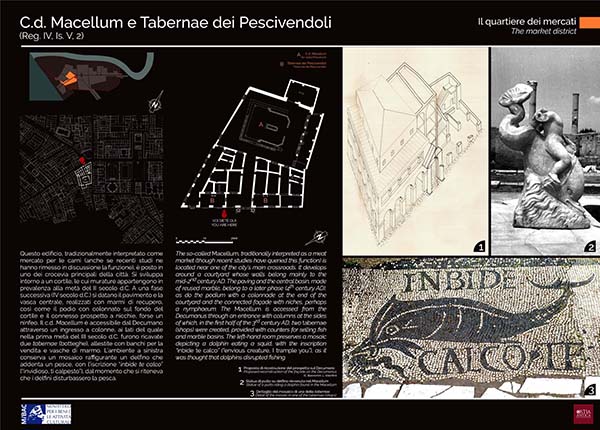
The so-called Macellum, traditionally interpreted as a meat market (though recent studies have queried this function) is located near one of the city’s main crossroads. It develops around a courtyard whose walls belong mainly to the mid-2nd century AD. The paving and the central...