
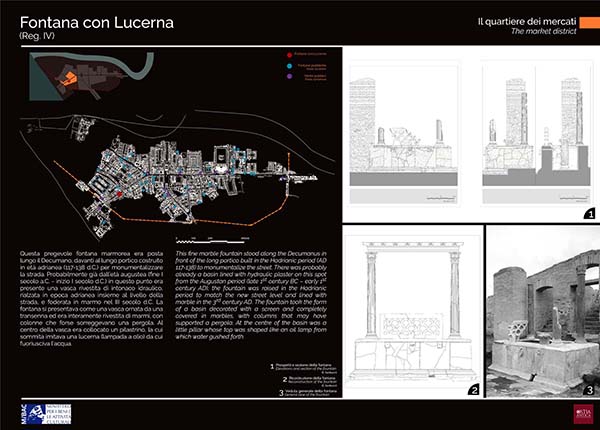
This fine marble fountain stood along the Decumanus in front of the long portico built in the Hadrianic period (AD 117-138) to monumentalize the street. There was probably already a basin lined with hydraulic plaster on this spot from the Augustan period (late 1st century BC – early 1st...
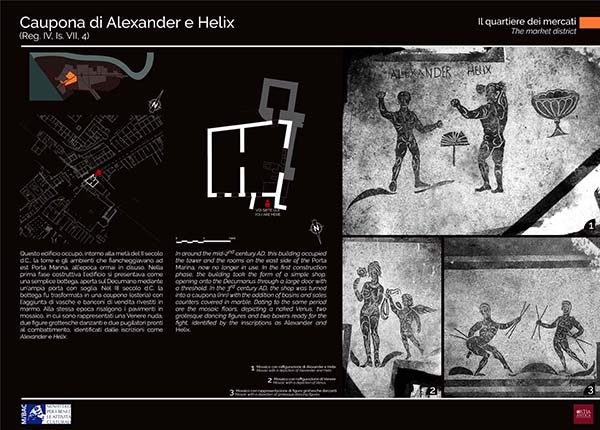
In around the mid-2nd century AD, this building occupied the tower and the rooms on the east side of the Porta Marina, now no longer in use. In the first construction phase, the building took the form of a simple shop, opening onto the Decumanus through a large door with a threshold....
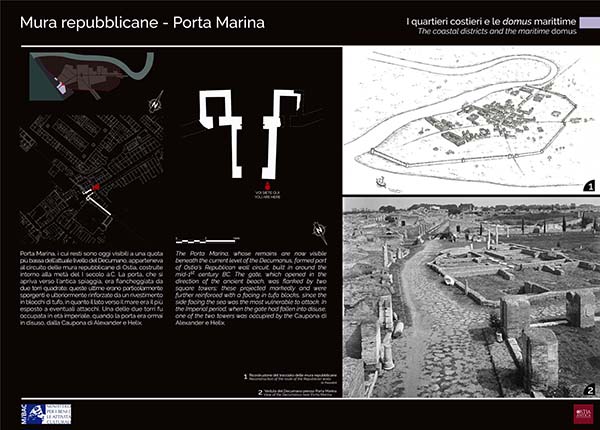
The Porta Marina, whose remains are now visible beneath the current level of the Decumanus, formed part of Ostia’s Republican wall circuit, built in around the mid-1st century BC. The gate, which opened in the direction of the ancient beach, was flanked by two square towers; these projected...
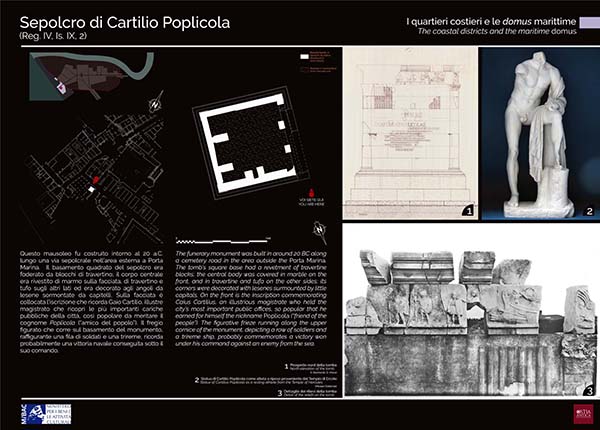
The funerary monument was built in around 20 BC along a cemetery road in the area outside the Porta Marina. The tomb’s square base had a revetment of travertine blocks; the central body was covered in marble on the front, and in travertine and tufa on the other sides; its corners...
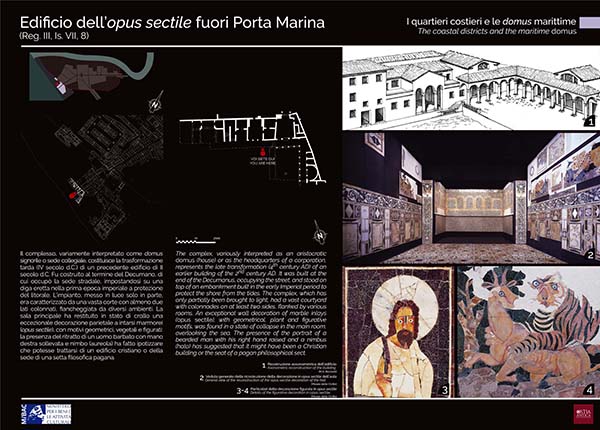
The complex, variously interpreted as an aristocratic 2 domus (house) or as the headquarters of a corporation, represents the late transformation (4th century AD) of an earlier building of the 2nd century AD. It was built at the end of the Decumanus, occupying the street, and stood on...
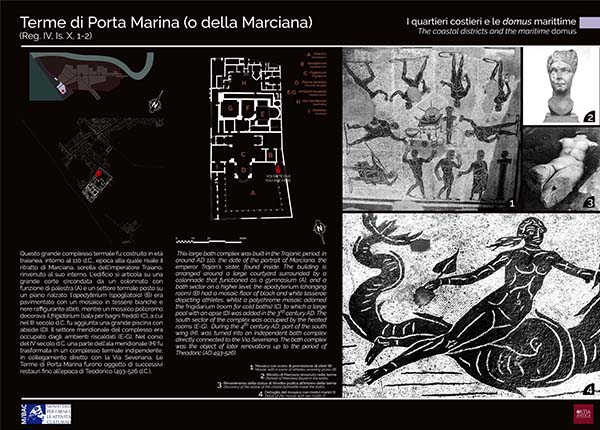
This large bath complex was built in the Trajanic period, in around AD 110, the date of the portrait of Marciana, the emperor Trajan’s sister, found inside. The building is arranged around a large courtyard surrounded by a colonnade that functioned as a gymnasium (A), and a bath sector on a...
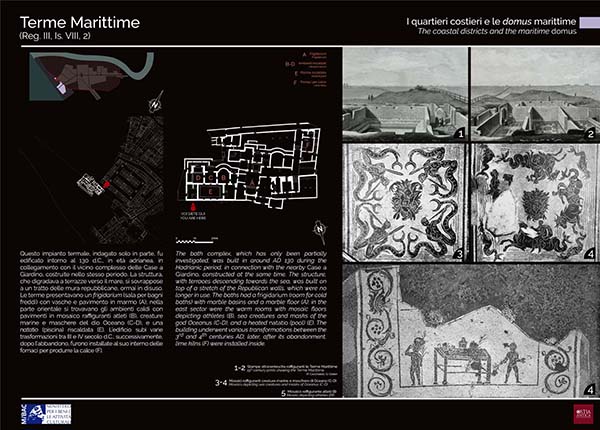
The bath complex, which has only been partially investigated, was built in around AD 130 during the Hadrianic period, in connection with the nearby Case a Giardino, constructed at the same time. The structure, with terraces descending towards the sea, was built on top of a stretch of...
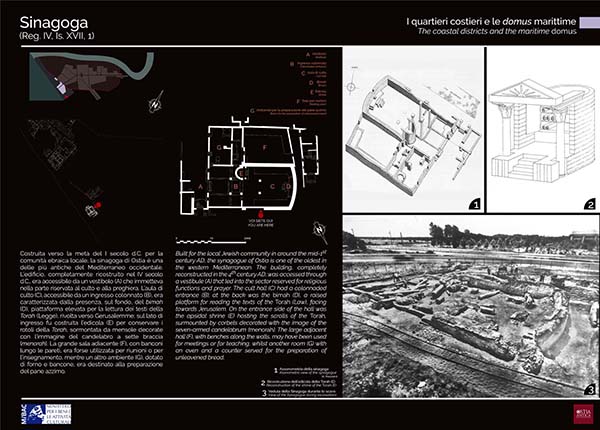
Built for the local Jewish community in around the mid-1st century AD, the synagogue of Ostia is one of the oldest in the western Mediterranean. The building, completely reconstructed in the 4th century AD, was accessed through a vestibule (A) that led into the sector reserved for religious...
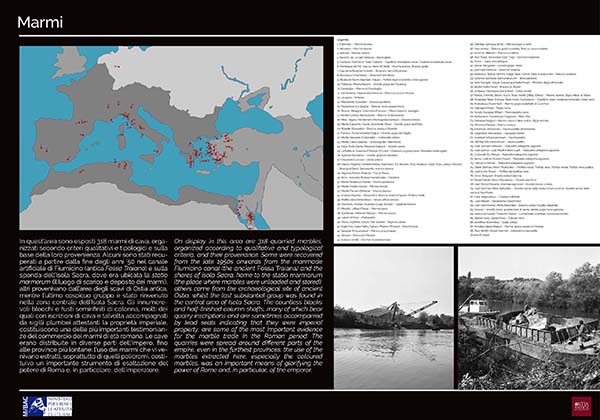
On display in this area are 318 quarried marbles, organized according to qualitative and typological criteria, and their provenance. Some were recovered from the late 1950s onwards from the manmade Fiumicino canal (the ancient Fossa Traiana) and the shores of Isola Sacra, home to the...
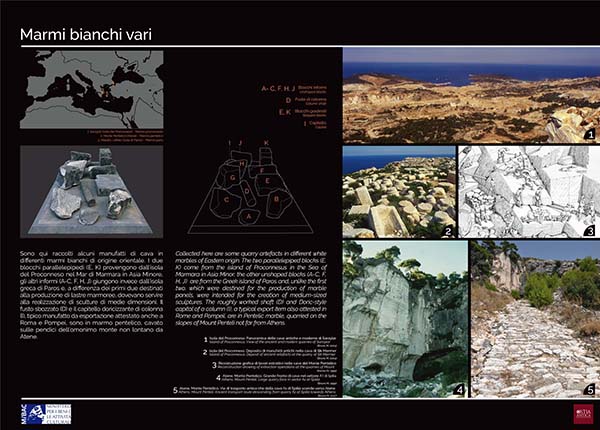
Collected here are some quarry artefacts in different white marbles of Eastern origin. The two parallelepiped blocks (E, K) come from the island of Proconnesus in the Sea of Marmara in Asia Minor; the other unshaped blocks (A-C, F, H, J) are from the Greek island of Paros and, unlike the...
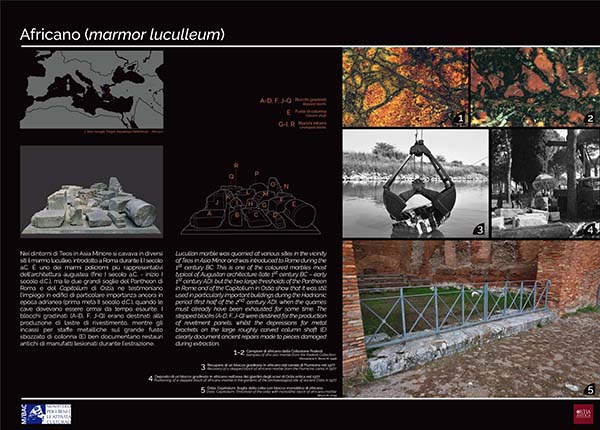
Lucullan marble was quarried at various sites in the vicinity of Teos in Asia Minor and was introduced to Rome during the 1st century BC. This is one of the coloured marbles most typical of Augustan architecture (late 1st century BC – early 1st century AD), but the two large thresholds of...
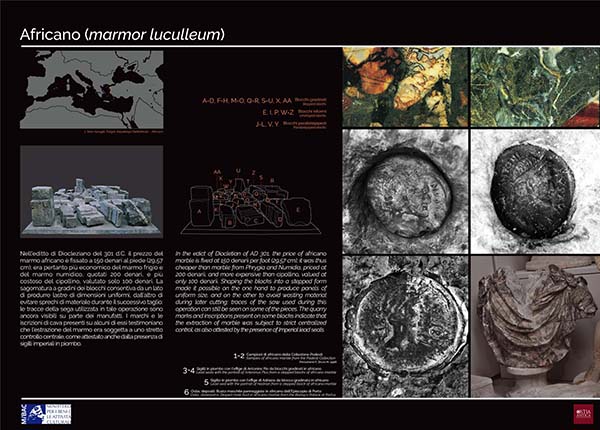
In the edict of Diocletian of AD 301, the price of africano marble is fixed at 150 denarii per foot (29.57 cm); it was thus cheaper than marble from Phrygia and Numidia, priced at 200 denarii, and more expensive than cipollino, valued at only 100 denarii....
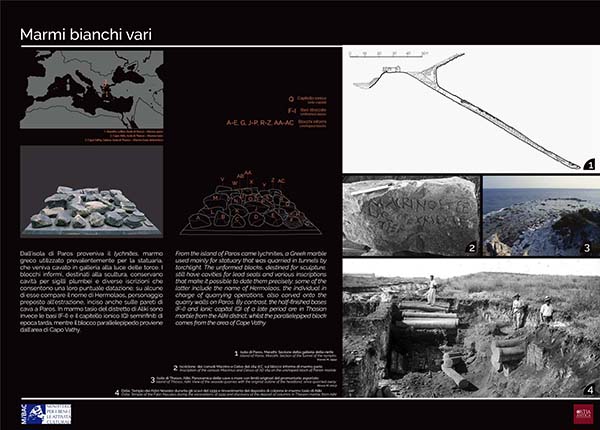
From the island of Paros came lychnites, a Greek marble used mainly for statuary that was quarried in tunnels by torchlight. The unformed blocks, destined for sculpture, still have cavities for lead seals and various inscriptions hat make it possible to date them precisely; some of the...