
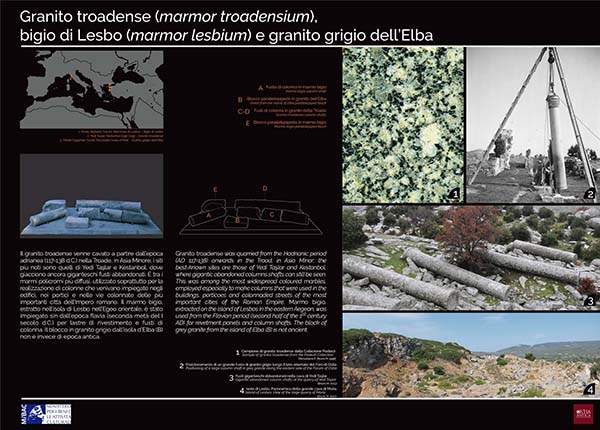
Granito troadense was quarried from the Hadrianic period (AD 117-138) onwards in the Troad, in Asia Minor; the best-known sites are those of Yedi Taşlar and Kestanbol, where gigantic abandoned columns shafts can still be seen. This was among the most widespread coloured marbles, employed...
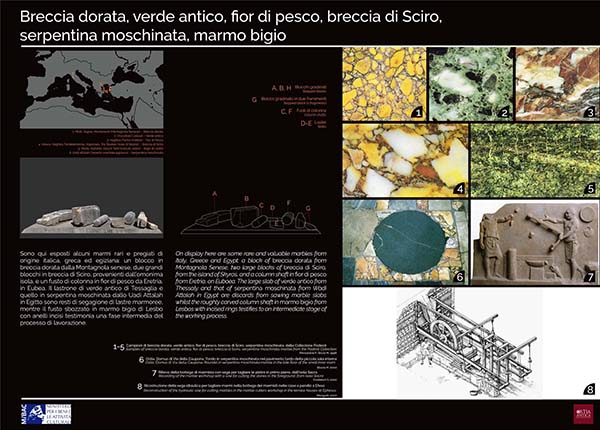
On display here are some rare and valuable marbles from Italy, Greece and Egypt: a block of breccia dorata from Montagnola Senese, two large blocks of breccia di Sciro, from the island of Skyros, and a column shaft in fior di pesco from Eretria, on Euboea. The large slab...
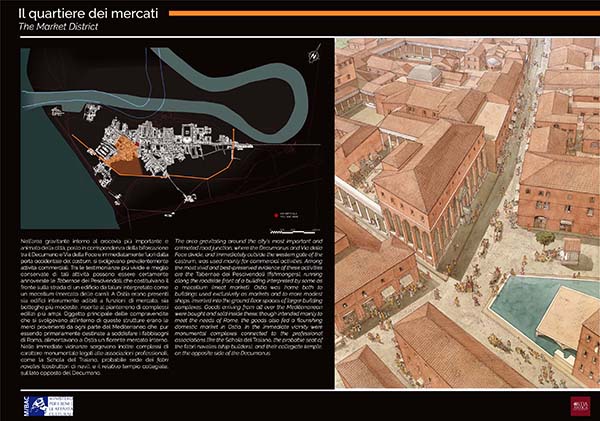
The area gravitating around the city’s most important and animated road junction, where the Decumanus and Via della Foce divide, and immediately outside the western gate of the castrum, was used mainly for commercial activities. Among the most vivid and best-preserved evidence of...
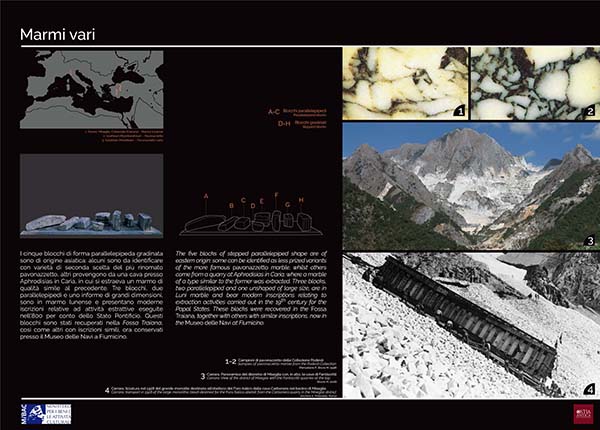
The five blocks of stepped parallelepiped shape are of eastern origin: some can be identified as less prized variants of the more famous pavonazzetto marble, whilst others come from a quarry at Aphrodisias in Caria, where a marble of a type similar to the former was extracted. Three...
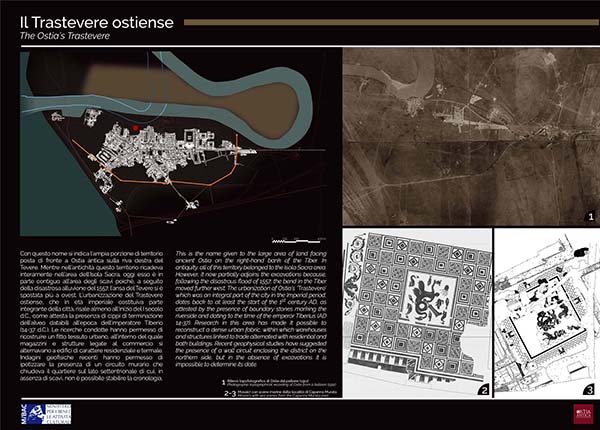
This is the name given to the large area of land facing ancient Ostia on the right-hand bank of the Tiber. In antiquity, all of this territory belonged to the Isola Sacra area. However, it now partially adjoins the excavations because, following the disastrous flood of 1557, the bend in the...

The sector of the city lying between the Republican wall circuit and the ancient coastline was initially used as a burial area, as shown by two monumental mausoleums of the late 1st century BC, the best known of which is the tomb of Cartilius Poplicola. The development of this district,...
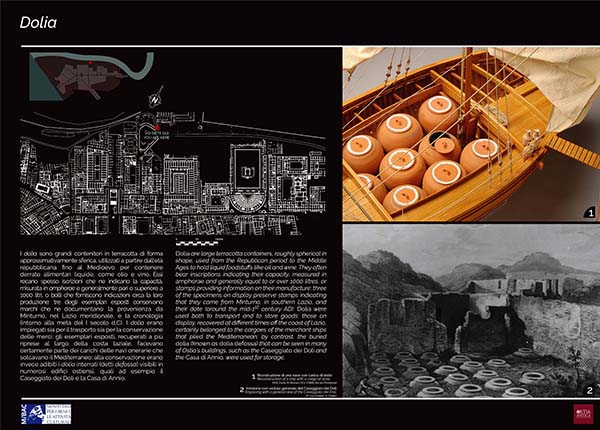
Dolia are large terracotta containers, roughly spherical in shape, used from the Republican period to the Middle Ages to hold liquid foodstuffs like oil and wine. They often bear inscriptions indicating their capacity, measured in amphorae and generally equal to or over 1000 litres, or...
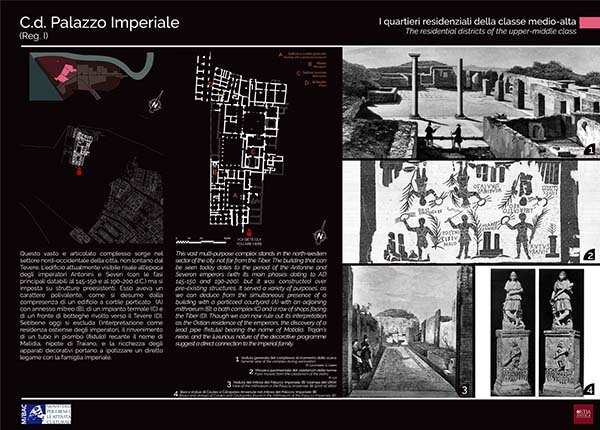
This vast multi-purpose complex stands in the north-western sector of the city, not far from the Tiber. The building that can be seen today dates to the period of the Antonine and Severan emperors (with its main phases dating to AD 145-150 and 190-200), but it was constructed over...

The name of Piccolo Mercato (“small market”) is given to a building, originally a goods warehouse, north-west of the Forum, near the river docks and next to one of the best-preserved stretches of the walls of the Republican castrum. Built in AD 119-120 and renovated in the...
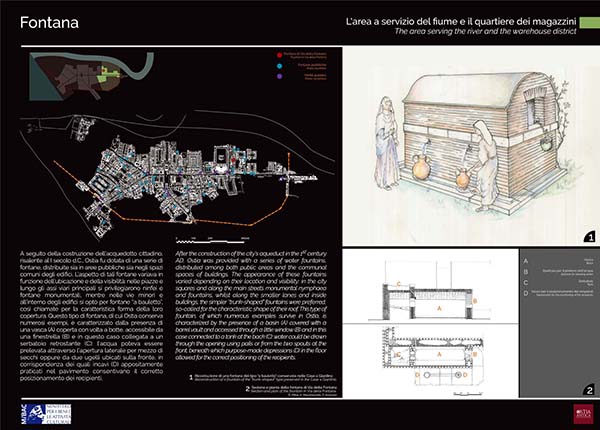
After the construction of the city’s aqueduct in the 1st century AD, Ostia was provided with a series of water fountains, distributed among both public areas and the communal spaces of buildings. The appearance of these fountains varied depending on their location and visibility: in the...
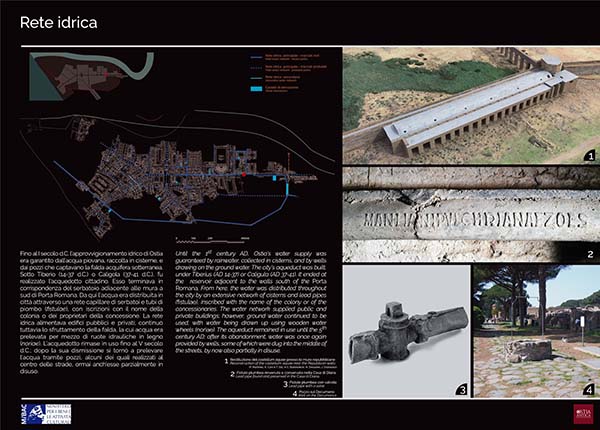
Until the 1st century AD, Ostia’s water supply was guaranteed by rainwater, collected in cisterns, and by wells drawing on the ground water. The city’s aqueduct was built, under Tiberius (AD 14-37) or Caligula (AD 37-41). It ended at the reservoir adjacent to the walls south of the...
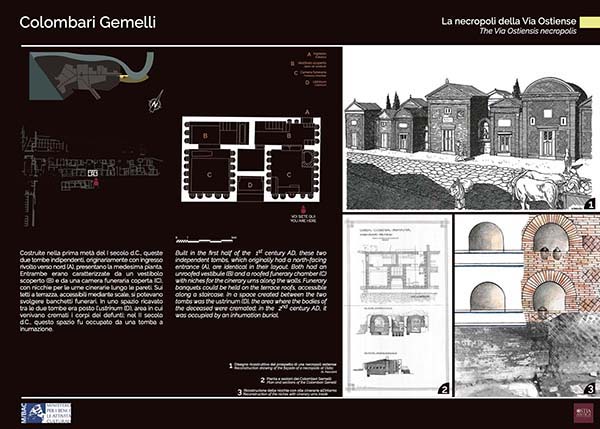
Built in the first half of the 1st century AD, these two independent tombs, which originally had a north-facing entrance (A), are identical in their layout. Both had an unroofed vestibule (B) and a roofed funerary chamber (C) with niches for the cinerary urns along the walls. Funerary...

To guarantee the harbour’s safety and the provisioning of Rome, a wall was built around the port towards the late 5th century AD. Much of the wall circuit was built against pre-existing buildings, thereby limiting the expenditure of time and materials to the bare essential. An example of...
The area between the quay and the Portico of Claudius was occupied, at least starting from the 2nd century AD, by buildings used mostly as warehouses. The western portion of the walls (the so-called “Antemurale”) conserve the remains of at least two warehouses, rebuilt between the...
Covering more than 3.5 hectares, Trajan’s Warehouses are the Roman Empire’s largest storage complex, with an extremely innovative plan organized around a central axis partially monumentalized by a double row of travertine columns in ashlar style, known as “Strada Colonnata”. The...
One of the storage cells in Trajan’s Warehouses, built during the Severan age (193-235 AD), bears, on the brick facing of its outer wall, an inscription in red paint indicating the number 488 in Roman numerals: XIID. This unusual detail most likely bears witness to an ancient system for...
The network of foundations of Trajan’s Warehouses is presented as a solid, uniform platform, raised by more than one metre above the ancient sea level. Extremely broad and deep, the foundations – first built in concrete in wooden formwork up to the floor level, then raised with a facing in...
In the layout of Trajan’s Warehouses, the Colonnaded Road ran perpendicularly to the Portico of Claudius. This monumental passage consisted of a double row of nine travertine columns, to a large degree conserved, which divides into three naves a space enclosed between the two masonry walls in...