

Built in the Claudian Age, the transverse channel had the function of linking the port complex with Fossa Traiana. From here, the river barges (naves caudicariae) were floated up the Fossa and then the Tiber to Rome, pulled by oxen or slaves using a towing system. The average time for this...
This monumental fountain is probably to be considered in connection with the residential complex identified beneath the nearby basilica, which may be dated to the first decades of the 4th century AD. For its semicircular plan with niches surrounded by aediculae, and for the employment of reused...
Around 430 AD, the building took on the typical basilica form, with the insertion of a semicircular apse on the northern side. Between the second half of the 5th and the middle of the 6th centuries AD, major modifications were made: the colonnades were extended, a new façade was built, and the...
The Early Christian basilica rises in a densely built-up area of the city lying between the hexagonal basin, the transverse channel, Via Portuensis, and Fossa Traiana. Its construction marks the final stage in a gradual process of transformation of pre-existing complexes built starting in the...
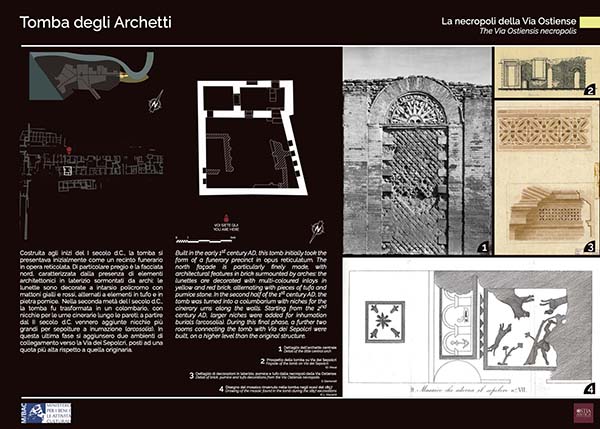
Built in the early 1st century AD, this tomb initially took the form of a funerary precinct in opus reticulatum. The north façade is particularly finely made, with architectural features in brick surmounted by arches: the lunettes are decorated with multi-coloured inlays in yellow...
Dating to the early medieval age (8th-9th centuries AD), this dwelling had as its base the perimeter walls of a Roman setting, stabilized with bricks cemented with clay. This was most likely a one-storey house (domus terrinea), similar to those also discovered in Rome in the Forum of Caesar. The...
Right from its creation, the port installation had problems with silting up; although it is unclear when this process definitively blocked access to the ports, it is certain that by the 15th century the entire basin had completely silted up to become marshland. In 1924, Prince Giovanni Torlonia,...
Built most likely between 110 and 117 AD by Emperor Trajan to allow ships to dock more safely while at the same time increasing the port’s activity, the hexagonal basin, designed perhaps by Apollodorus of Damascus, was dug into the dry land east of the pre-existing Harbour of Claudius. The...
A warehouse complex referred to as the Severan Warehouses is placed in correspondence with the hexagonal basin, at the point of connection with the harbour’s entrance channel, replacing an earlier, Trajan-Age building of which only a wall in the northern façade remains visible. Although...
The complex most likely presents a C-shaped plan, with two short arms oriented north-south, and the long arm east-west. The eastern short arm is parallel and adjacent to Trajan’s basin, while the second short side is no longer visible. The complex was articulated on three storeys. On the...
This terrace corresponds to the complex’s first storey, and is situated on the eastern side of the Severan Warehouses, in correspondence with one of the ramps leading from the hexagonal basin to the two upper storeys, clearly designed for heavy loads. From here, one may enjoy an exceptional...
Behind the Severan Warehouses, against the back wall and facing the basin of Claudius, various structures were installed on a small, internal beach in Late Antiquity, including a building made with the masonry technique defined as opus vittatum mixtum, characterized by rows of rectangular tuff...
The construction of this bath complex dates to the turn of the 4th century AD. From the entrance, one accesses the corridor serving the furnaces (A) and the one (B) leading to the bath environments, organized around a hallway (C): the heated rooms are to the north and the cold ones to the south,...
This internal pier, which separates the access channel to Trajan’s hexagonal basin from the Harbour of Claudius, owes its name to the lighthouse located at its head, which could still be seen until the first decades of the 20th century. This large structure, oriented east-west and totalling...
The main body of the pier’s head was built using wooden formwork, filled with poured hydraulic mortar; a layer of tiles, still fully visible on the northern face, rested on this, in order to level the structure. The most ancient concrete nucleus had a facing in opus mixtum. Above the head,...
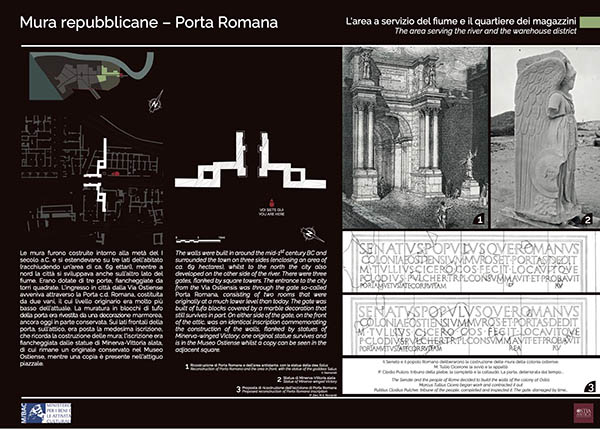
The walls were built in around the mid-1st century BC and surrounded the town on three sides (enclosing an area of ca. 69 hectares), whilst to the north the city also developed on the other side of the river. There were three gates, flanked by square towers. The entrance to the city from the...
The two main construction phases after the Claudian Age are those from the Antonine and Severan Ages, although Late Antique interventions have been identified; among these, of particular importance is the construction of the city walls in the late 5th century AD. The Antonine work sites adopted...
Claudius’ project, probably not yet completed when the port was inaugurated in 64 AD, provided for the unloading and transit of goods through the spaces between the columns, directly in the porticos’ circulation spaces, adequately elevated above sea level. Along with the plugging of all the...