
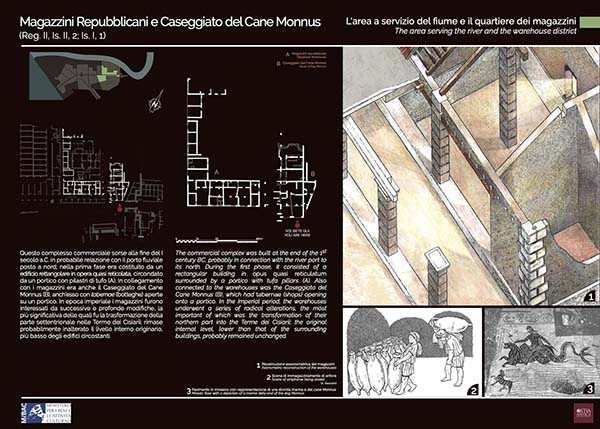
The commercial complex was built at the end of the 1st century BC, probably in connection with the river port to its north. During the first phase, it consisted of a rectangular building in opus quasi reticulatum surrounded by a portico with tufa pillars (A). Also connected to the warehouses was...

Starting in the 1920s, Prince Giovanni Torlonia had a strong influence over the site’s plant life. In addition to the pine trees still present today, subsequent years saw the planting of numerous fruit trees especially in the lands around the farmstead, now no longer to be seen; the only...
Bamboo is an ornamental grass marked by enormous morphological variability. In botanical terms, it is a very vigorous evergreen bush, with a bundled root system. The culms are woody and, generally, erect in bearing. Ecologically sustainable and highly sturdy while being very light at the same...
The tombs visible today are a small part of the larger burial ground that stretched south of Ostia along the Via Laurentina; the funerary buildings, arranged on several levels, were aligned along the Via Laurentina and the connected roads, delimiting to the north a large plaza dotted with...
The Laurentina Necropolis offers rich documentation of the rituals connected to death and burial in the Roman world. As elsewhere, the practices of interment and cremation coexisted since the Late Republic, with the latter ritual prevailing until the 2nd century AD. Cremation took place...
Until the construction of the coastal Via Severiana in the early 3rd century AD, Via Laurentina (which took its name of the variously identified city of Laurentum) was the main link between Ostia and southern Latium. Oriented in a northwest/southwest axis, the road entered the...
Placed to the west of the intersection between Via Laurentina and a secondary road, these tombs bear eloquent testimony to the stratification of funerary buildings belonging to the different phases in the life of the necropolis. In fact, placed on top of the funerary enclosures in opus...
These tombs, placed to the sides and at the centre of the plaza that marks the northern limit of the archaeological area, present extreme chronological and typological variety. While the northern side is defined by funerary enclosures in opus reticulatum from the Augustan Age (Tombs 41 and...
Belonging to D(ecimus) Folius Dionysi l(ibertus) Mela and dated to the first half of the 1st century AD, it is also known as the ‘Tomb of Orpheus in the Underworld’ due to the subject of the main fresco, now at the Vatican Museums. With the adjacent burials, it exemplifies the...
Tomb 32, built between the late 1st century BC – early 1st century AD, is a kind of prototype for the nearby columbaria, from which it is distinguished by the presence of the ustrinum, adjacent to but separate from the main body. Its interior organized like the nearby Tomb...
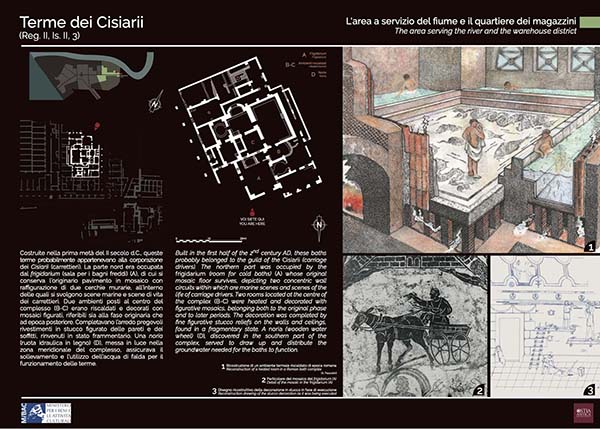
Built in the first half of the 2nd century AD, these baths probably belonged to the guild of the Cisiarii (carriage drivers). The northern part was occupied by the frigidarium (room for cold baths) (A) whose original mosaic floor survives, depicting two concentric wall...
This tomb, placed in an eminent position at the intersection between Via Laurentina and a diverticulum of that road, is to date the oldest one documented in the necropolis (50-30 BC): it is an enclosure in opus reticulatum that encloses a square monument lined with travertine on the...
Standing out in the row of buildings located between Via Laurentina and the internal tomb road is Tomb 18, of the chamber type, also called the Tomb “of the Priestess of Isis” for the fresco that adorned a niche in the façade. Inside, the walls are decorated with frescos with floral and...
The different levels of the grade planes suggest that the tombs placed at the sides of the tomb road were built in different eras, between the early 1st and the 2nd centuries AD. Facing the southern side are Tomb 23, characterized by the presence of a sort of unique peristyle, and Tomb 29,...
Located at the mouth of the Tiber, the territory that the ancient literary sources call Isola Sacra is an artificial island bounded by the Fossa Traiana to the north (the modern-day Fiumicino canal), by the Tiber to the east and south, and by the sea to the west. The area extends further west...
In the 1920s, during the works to drain the territory and the construction of farm houses in the area assigned to the veterans’ organization Opera Nazionale Combattenti (O.N.C.), tombs decorated with paintings, stuccowork, and mosaics, which to this day constitute the northernmost nucleus of...
In the early phase (1st century A.D.) the Necropolis consisted of burials in semi-cylindrical masonry caissons irregularly arranged along the Via Flavia-Severiana, which in this section was raised and dual carriageway. The funerary buildings were mainly built between the early 2nd and mid-3rd...