

The choice of cremation or interment has no influence on the tomb’s outward appearance, but conditions its interior articulation: the lower register of the walls might house arcosolia for the interred, and the upper one niches containing ollas for the cremated. Beneath the floor, there are...
Tomb 1: cube with pyramid roof, dating to the Age of the Antonines (138-192 AD)
Tombs 2-9: cella-type tomb; their interiors present arcosolia in the walls and fossae delimited by low walls in the floors (formae), intended for the interred and dating...
Tomb 12: cella-type tomb; its interior is organized for the interment ritual in two orders of arcosolia in the walls, and in formae beneath the floor level (formae). Dating: first decades of the 3rd century AD.
Tombs 13, 14, and 15: cella-type tomb;...
Tomb 19: cella-type tomb; the interior was carefully plastered with a rich painted decoration. Dating: mid-2nd century AD. Tombs 20 and 21: cella-type tomb; their façades have slits, terracotta cornices and recesses for the epigraphs framed by marble semi-capitals. The interior...
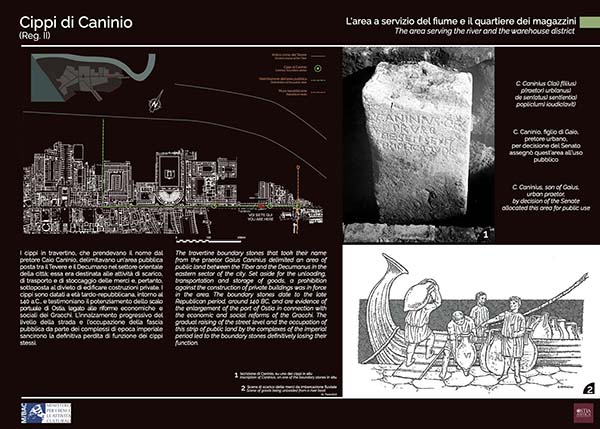
The travertine boundary stones that took their name from the praetor Gaius Caninius delimited an area of public land between the Tiber and the Decumanus in the eastern sector of the city. Set aside for the unloading, transportation and storage of goods, a prohibition against the...
Tomb 29: a cella-type tomb with an L-shaped enclosure and upper level built at a later time. On the façade are copies of fictile reliefs with scenes related to activities connected to the production and sale of iron utensils, alluding to the profession practised by the deceased...
Tomb 37: cella-type tomb; was intended for the interment ritual with arcosolia and formae. Dating: 2nd – 3rd century AD.
Tomb 38: cella-type tomb, with enclosure and probable upper level; had a side entrance. It is placed over previous burials and...
This area features various types of funerary buildings and so-called ‘poor’ simple tombs (over 600), mostly individual.
Tombs 54 and 55: cella-type tombs with preparations for banquets placed against the façades and interiors set up for the mixed ritual. In Tomb...
This sector’s current appearance is the result of later elements placed upon the older buildings and is characterized by the presence on the façade of masonry preparations for banquets.
Tomb 72: the cella-type tomb, organized for the mixed ritual, has niches with...
The continuity of the front of Tombs 87-95 is the result of later elements placed upon the older Tombs 85 and 86.
Tomb 85: cella-type tomb, intended for the cremation ritual. Dating: 120-150 AD.
Tomb 87: cella-type tomb with contemporary...
Of this group of Severan Age (197-235 AD) tomb buildings, only the sub-floor levels, occupied by formae on a number of levels, are conserved.
Placed along the road are some of the marble finds discovered in the Necropolis and the adjacent land during the excavations by Guido Calza...
The excavation campaigns conducted from 1989-1990 onwards have allowed the size and volumetry of the eastern side of the Necropolis to be recovered. The group of buildings from the Antonine Age brought to light developed around Tomb E30, with successive additions and transformations lasting...
The main nuclei of this group of buildings from the Age of the Antonines (138-192 AD) are Tomb E35 with its enclosure (E34), cella E40, and the E43 cella-enclosure complex; the remaining structures document the gradual occupation of the leftover space (Tomb E36 and E38) and of the road front...
The presence of Tombs E48, E50 and E46, from the Age of the Antonines (138-192 AD, attests to the burial ground’s eastward continuation.
Tombs E45, E46, and E47: this complex’s layout is quite articulated, with an enclosure in front of two cellae intended for the...
The approximately two thousand burials in the Portus Necropolis, a skeletal sample that is exceptional for its numbers and the preservation of the remains, have for several years been the subject of an anthropological investigation that has made significant contributions to knowledge about...
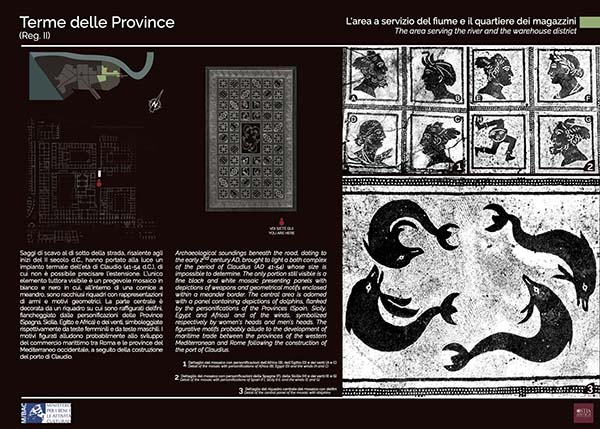
Archaeological soundings beneath the road, dating to the early 2nd century AD, brought to light a bath complex of the period of Claudius (AD 41-54) whose size is impossible to determine. The only portion still visible is a fine black and white mosaic presenting panels with depictions of...
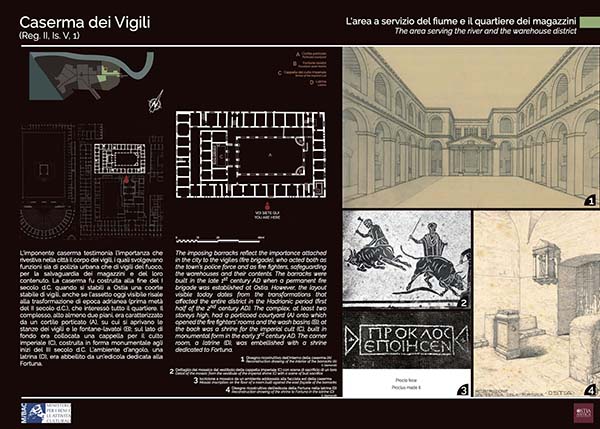
The imposing barracks reflect the importance attached in the city to the vigiles (fire brigade), who acted both as the town’s police force and as fire fighters, safeguarding the warehouses and their contents. The barracks were built in the late 1st century AD when a permanent fire...
The interior walls are richly decorated with paintings. In the lower register, geometric and figured motifs may be seen, such as winged griffins and a tragic mask, while a marsh landscape with two seahorses is depicted in the rear wall’s arcosolium. The same wall’s central niche was...