

The tomb’s interior contained a painted decoration now fully detached and conserved at Depositi Ostiensi. The rear wall’s central aedicule was decorated with perhaps a female figure, oriented towards which are two winged Victories. On the side walls were depicted at left a heroicized...
The tomb belongs to a sector of the Necropolis, outside the visiting area (A), excavated by Guido Calza in the late 1930s, and later reburied for conservation problems after removal of the painted, marble, and mosaic decoration. In the specific case, the painted false cross-vaulted ceiling,...
The tomb consists of two adjacent cellae intended for the interment ritual, with independent entrance and linked by a large enclosure in front, in its turn articulated in an L-shaped portico. Of particular interest is the masonry of the opus spicatum façade (in the form of wheat ears) and the...
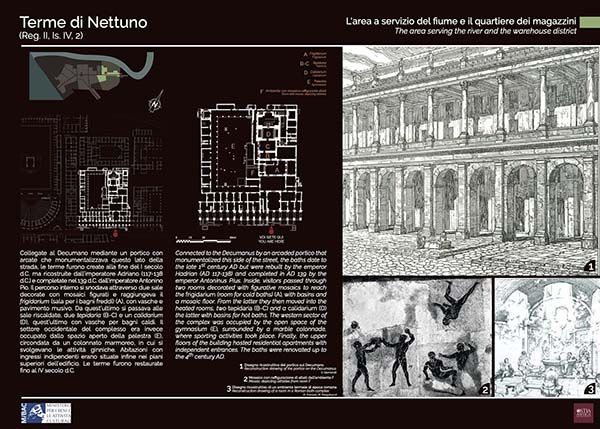
Connected to the Decumanus by an arcaded portico that monumentalized this side of the street, the baths date to 1 the late 1st century AD but were rebuilt by the emperor Hadrian (AD 117-138) and completed in AD 139 by the emperor Antoninus Pius. Inside, visitors passed through two...
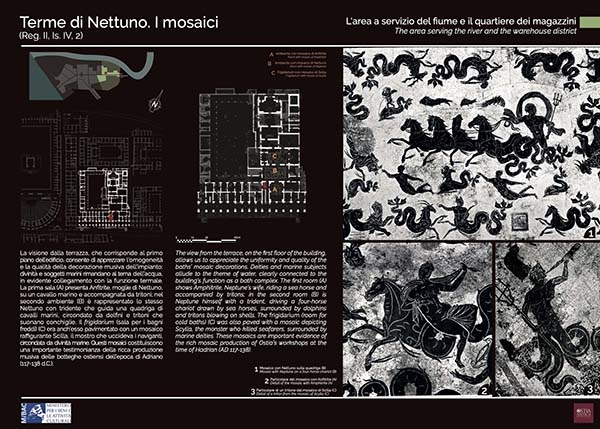
The view from the terrace, on the first floor of the building, allows us to appreciate the uniformity and quality of the baths’ mosaic decorations. Deities and marine subjects allude to the theme of water, clearly connected to the building’s function as a bath complex. The first room (A)...
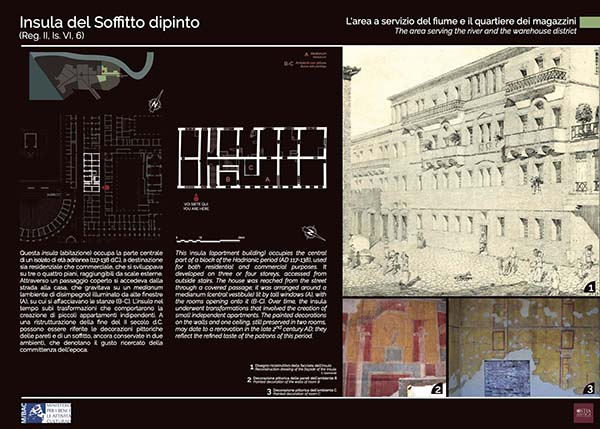
This insula (apartment building) occupies the central part of a block of the Hadrianic period (AD 117-138), used for both residential and commercial purposes. It developed on three or four storeys, accessed from outside stairs. The house was reached from the street through a covered...
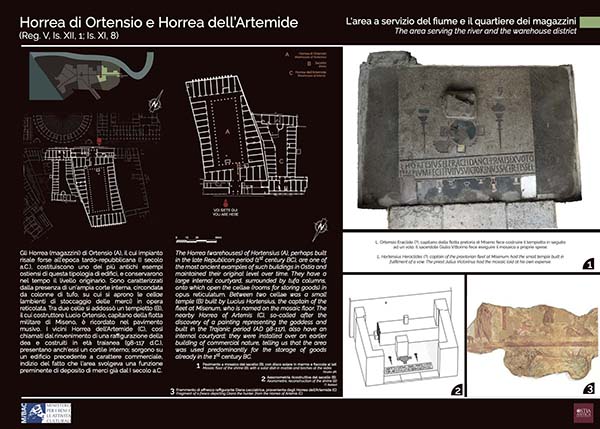
The Horrea (warehouses) of Hortensius (A), perhaps built in the late Republican period (1st century BC), are one of the most ancient examples of such buildings in Ostia and maintained their original level over time. They have a large internal courtyard, surrounded by tufa columns, onto which...
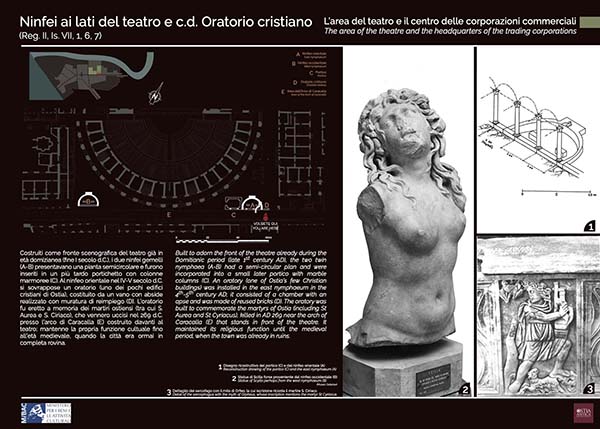
Built to adorn the front of the theatre already during the Domitianic period (late 1st century AD), the two twin nymphaea (A-B) had a semi-circular plan and were incorporated into a small later portico with marble columns (C). An oratory (one of Ostia’s few Christian buildings) was...
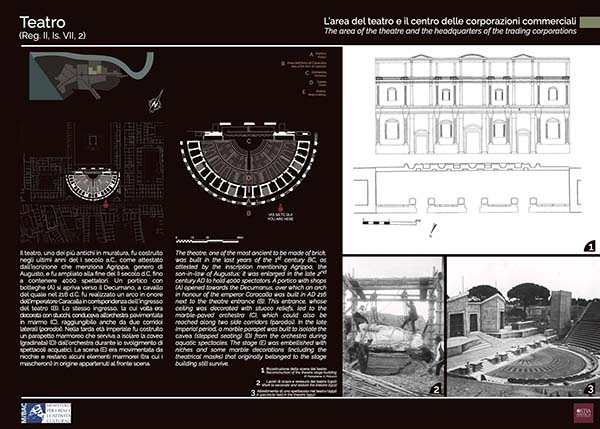
The theatre, one of the most ancient to be made of brick, was built in the last years of the 1st century BC, as attested by the inscription mentioning Agrippa, the son-in-law of Augustus; it was enlarged in the late 2nd century AD to hold 4000 spectators. A portico with shops (A) opened...
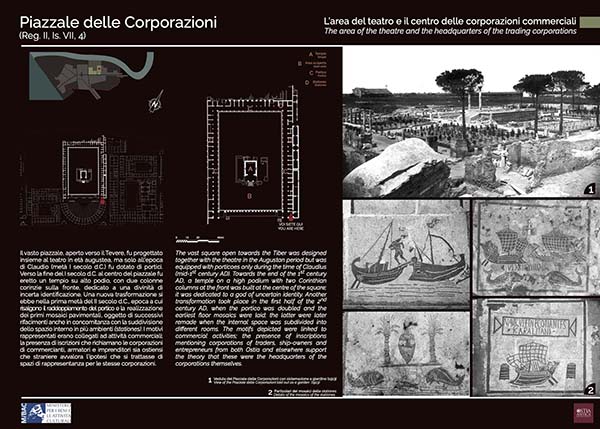
The vast square open towards the Tiber was designed together with the theatre in the Augustan period but was equipped with porticoes only during the time of Claudius (mid-1st century AD). Towards the end of the 1st century AD, a temple on a high podium with two Corinthian columns at the front...
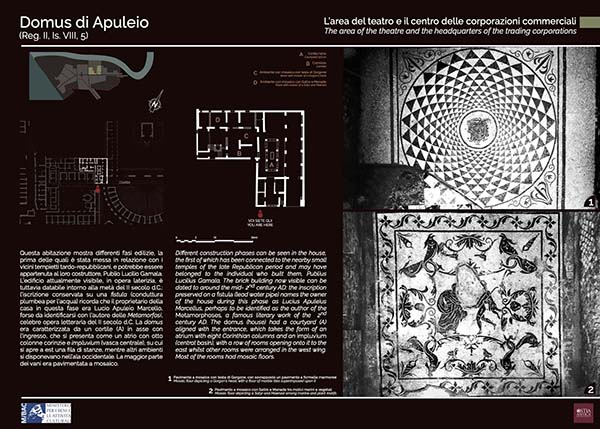
Different construction phases can be seen in the house, the first of which has been connected to the nearby small temples of the late Republican period and may have belonged to the individual who built them, Publius Lucilius Gamala. The brick building now visible can be dated to around the...
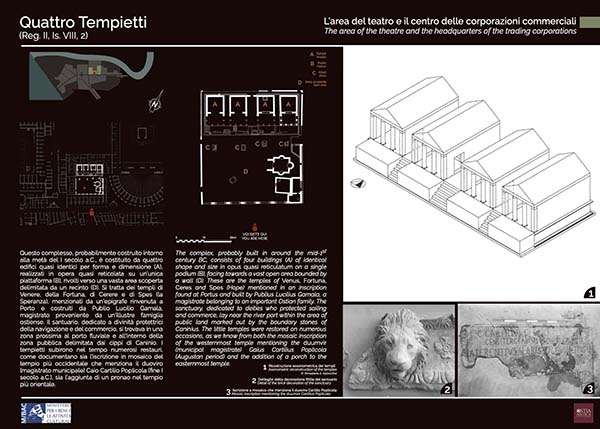
The complex, probably built in around the mid-1st century BC, consists of four buildings (A) of identical shape and size in opus quasi reticulatum on a single podium (B), facing towards a vast open area bounded by a wall (D). These are the temples of Venus, Fortuna, Ceres and...
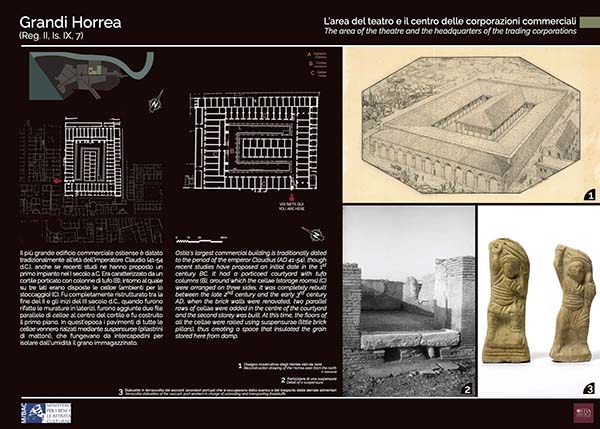
Ostia’s largest commercial building is traditionally dated to the period of the emperor Claudius (AD 41-54), though recent studies have proposed an initial date in the 1st century BC. It had a porticoed courtyard with tufa columns (B), around which the cellae (storage rooms) (C) were...
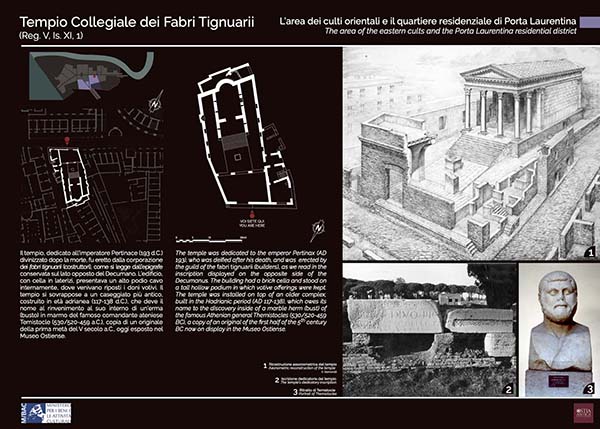
The temple was dedicated to the emperor Pertinax (AD 193), who was deified after his death, and was erected by the guild of the fabri tignuarii (builders), as we read in the inscription displayed on the opposite side of the Decumanus. The building had a brick cella and stood on a tall...
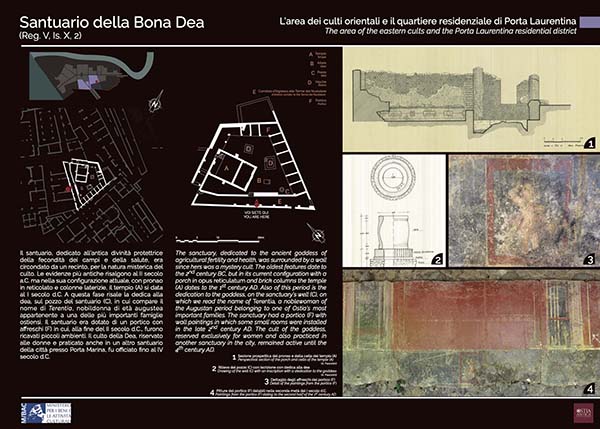
The sanctuary, dedicated to the ancient goddess of agricultural fertility and health, was surrounded by a wall 3 since hers was a mystery cult. The oldest features date to the 2nd century BC, but in its current configuration with a porch in opus reticulatum and brick columns the...
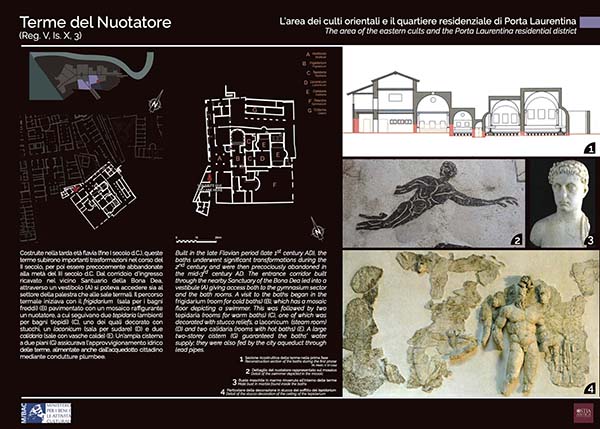
Built in the late Flavian period (late 1st century AD), the baths underwent significant transformations during the 2nd century and were then precociously abandoned in the mid-3rd century AD. The entrance corridor built through the nearby Sanctuary of the Bona Dea led into a vestibule (A)...
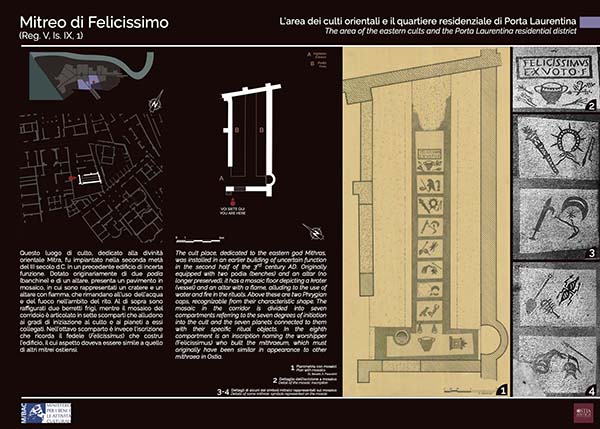
The cult place, dedicated to the eastern god Mithras, was installed in an earlier building of uncertain function in the second half of the 3rd century AD. Originally equipped with two podia (benches) and an altar (no longer preserved), it has a mosaic floor depicting a krater (vessel)...
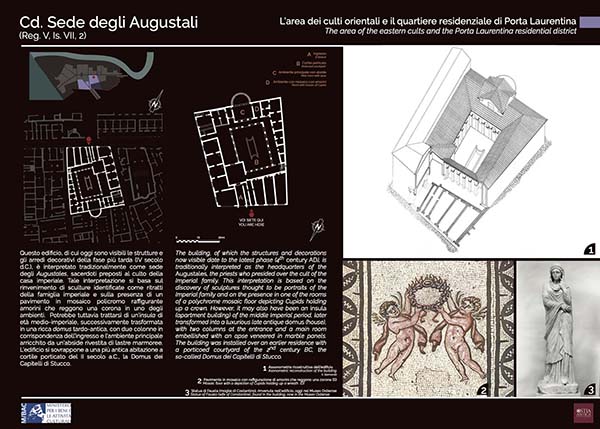
The building, of which the structures and decorations now visible date to the latest phase (4th century AD), is traditionally interpreted as the headquarters of the Augustales, the priests who presided over the cult of the Imperial family. This interpretation is based on the...