
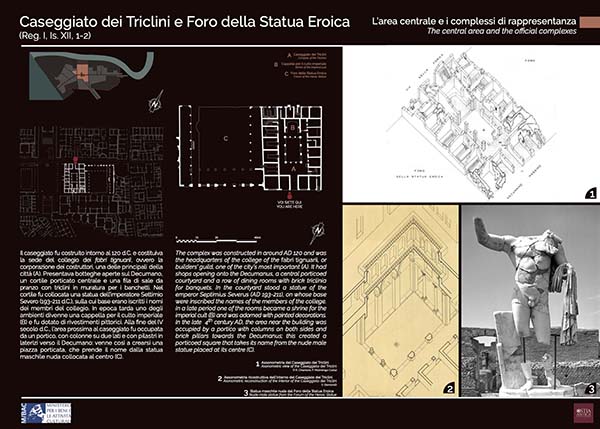
The complex was constructed in around AD 120 and was the headquarters of the college of the fabri tignuarii, or builders’ guild, one of the city’s most important (A). It had shops opening onto the Decumanus, a central porticoed courtyard and a row of dining rooms with brick...
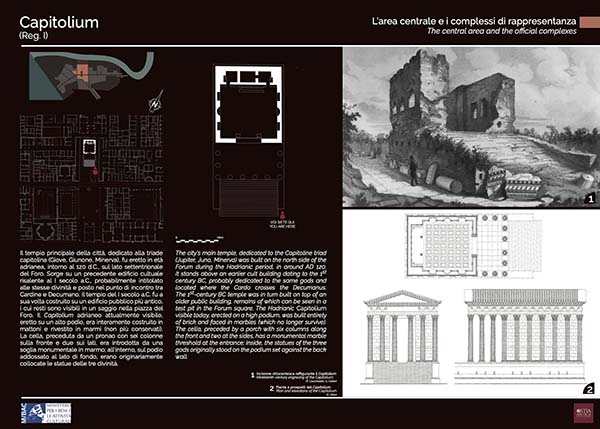
The city’s main temple, dedicated to the Capitoline triad (Jupiter, Juno, Minerva) was built on the north side of the Forum during the Hadrianic period, in around AD 120. It stands above an earlier cult building dating to the 1st century BC, probably dedicated to the same gods and located...
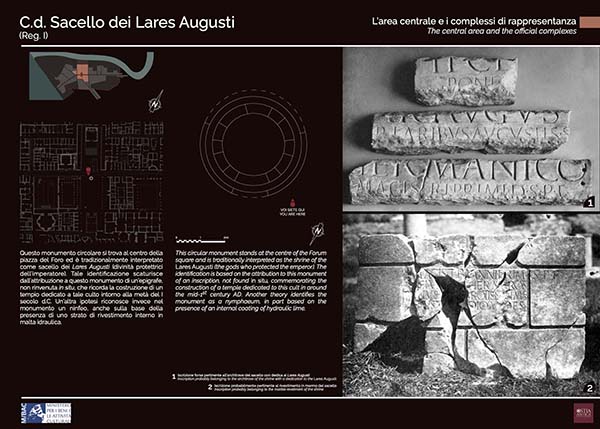
This circular monument stands at the centre of the Forum square and is traditionally interpreted as the shrine of the Lares Augusti (the gods who protected the emperor). The identification is based on the attribution to this monument of an inscription, not found in situ,...
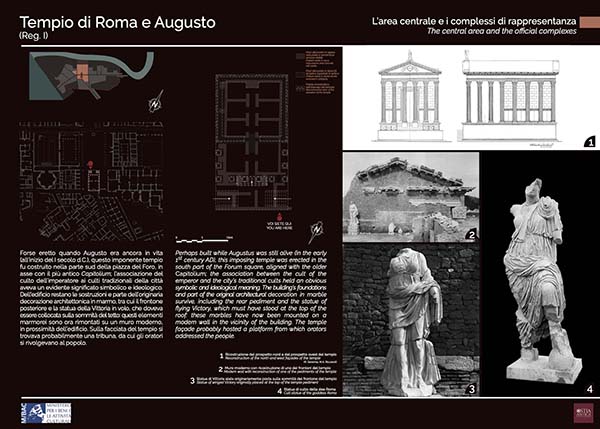
Perhaps built while Augustus was still alive (in the early 1st century AD), this imposing temple was erected in the south part of the Forum square, aligned with the older Capitolium; the association between the cult of the emperor and the city’s traditional cults held an obvious...
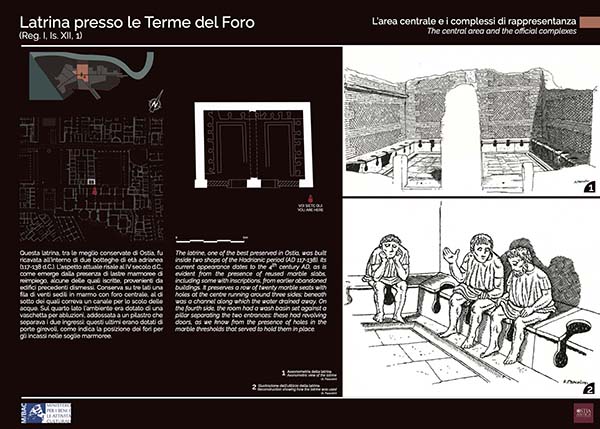
The latrine, one of the best preserved in Ostia, was built inside two shops of the Hadrianic period (AD 117-138). Its current appearance dates to the 4th century AD, as is evident from the presence of reused marble slabs, including some with inscriptions, from earlier abandoned buildings. It...
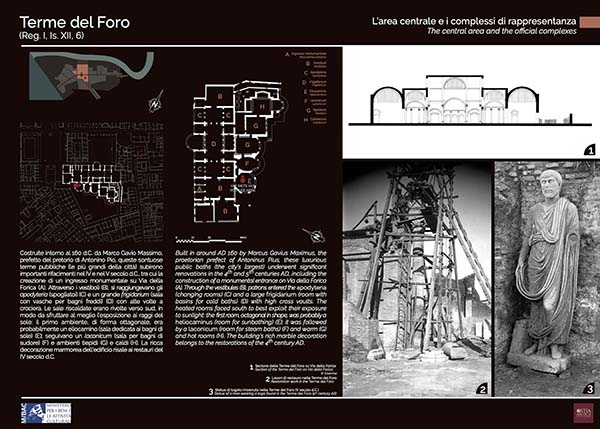
Built in around AD 160 by Marcus Gavius Maximus, the praetorian prefect of Antoninus Pius, these luxurious public baths (the city’s largest) underwent significant renovations in the 4th and 5th centuries AD, including the construction of a monumental entrance on Via della Forica (A)....
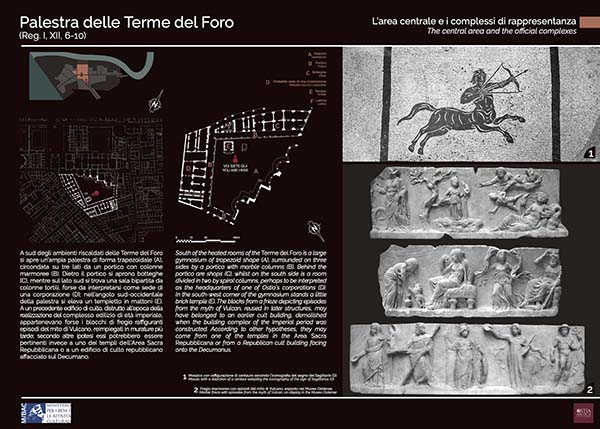
South of the heated rooms of the Terme del Foro is a large gymnasium of trapezoid shape (A), surrounded on three sides by a portico with marble columns (B). Behind the portico are shops (C), whilst on the south side is a room divided in two by spiral columns, perhaps to be interpreted...
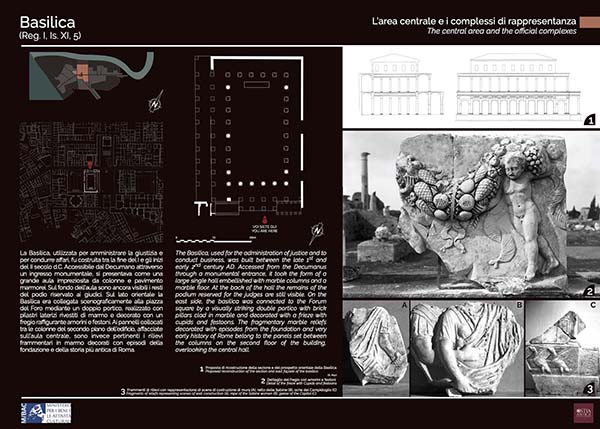
The Basilica, used for the administration of justice and to conduct business, was built between the late 1st and early 2nd century AD. Accessed from the Decumanus through a monumental entrance, it took the form of a large single hall embellished with marble columns and a marble floor. At the...
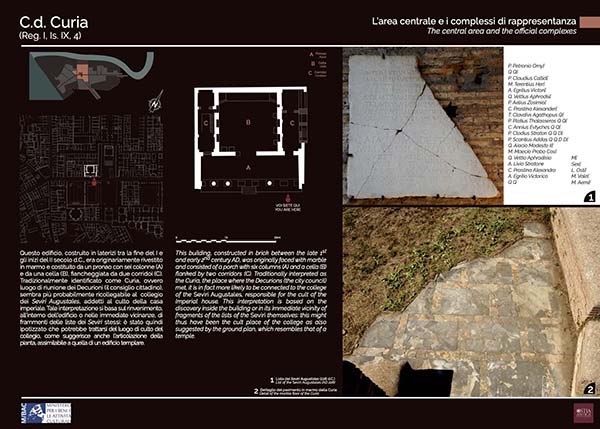
This building, constructed in brick between the late 1st and early 2nd century AD, was originally faced with marble and consisted of a porch with six columns (A) and a cella (B) flanked by two corridors (C). Traditionally interpreted as the Curia, the place where the Decurions (the city...
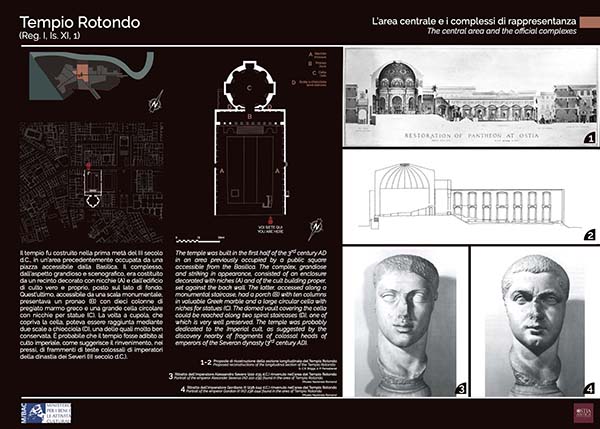
The temple was built in the first half of the 3rd century AD in an area previously occupied by a public square accessible from the Basilica. The complex, grandiose and striking in appearance, consisted of an enclosure decorated with niches (A) and of the cult building proper, set against the...
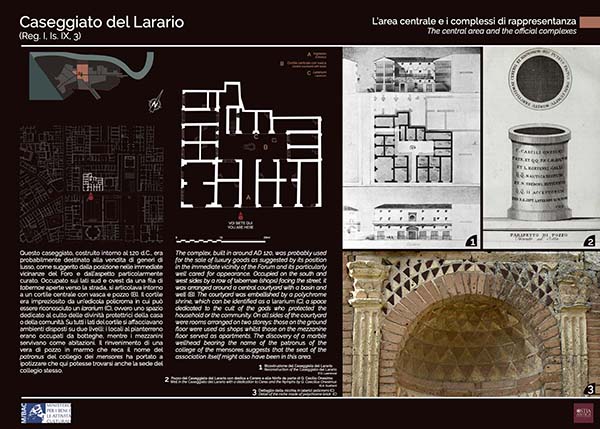
The complex, built in around AD 120, was probably used for the sale of luxury goods as suggested by its position in the immediate vicinity of the Forum and its particularly well cared for appearance. Occupied on the south and west sides by a row of tabernae (shops) facing the street,...
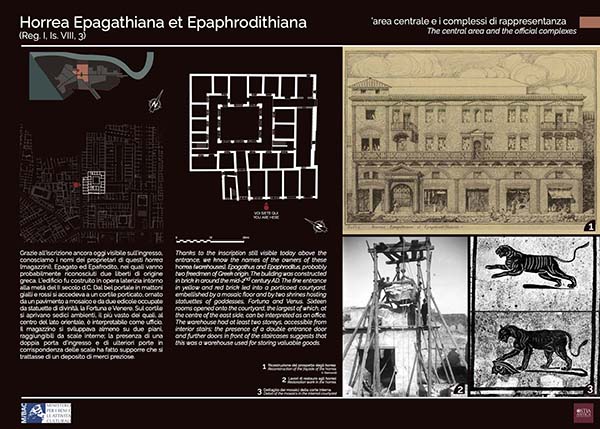
Thanks to the inscription still visible today above the entrance, we know the names of the owners of these horrea (warehouses), Epagathus and Epaphroditus, probably two freedmen of Greek origin. The building was constructed in brick in around the mid-2nd century AD. The fine entrance...
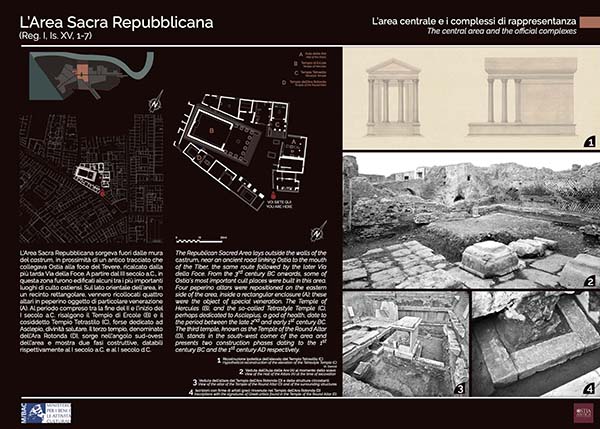
The Republican Sacred Area lays outside the walls of the castrum, near an ancient road linking Ostia to the mouth of the Tiber, the same route followed by the later Via della Foce. From the 3rd century BC onwards, some of Ostia’s most important cult places were built in this area....
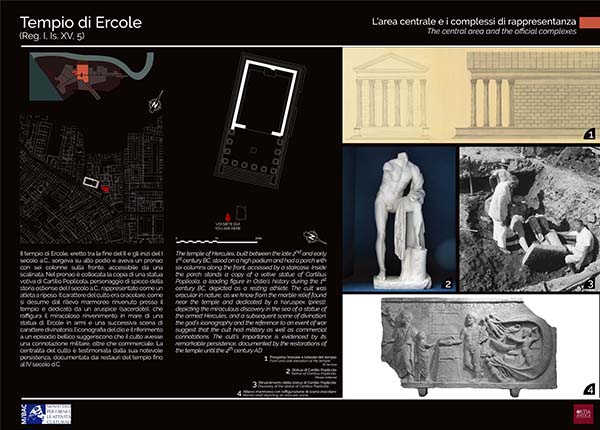
The temple of Hercules, built between the late 2nd and early 1st century BC, stood on a high podium and had a porch with six columns along the front, accessed by a staircase. Inside the porch stands a copy of a votive statue of Cartilius 23 Poplicola, a leading figure in Ostia’s...
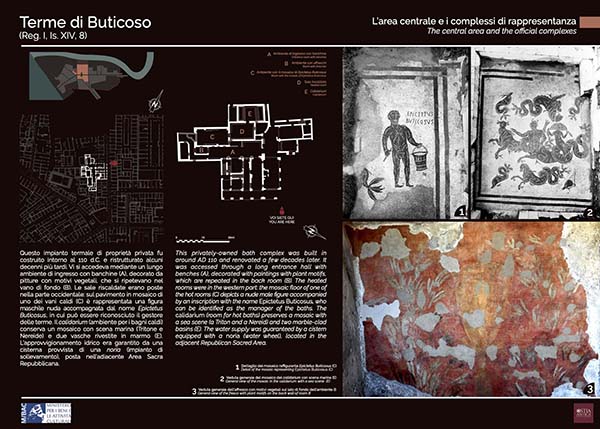
This privately-owned bath complex was built in around AD 110 and renovated a few decades later. It was accessed through a long entrance hall with benches (A), decorated with paintings with plant motifs, which are repeated in the back room (B). The heated rooms were in the western part: the...
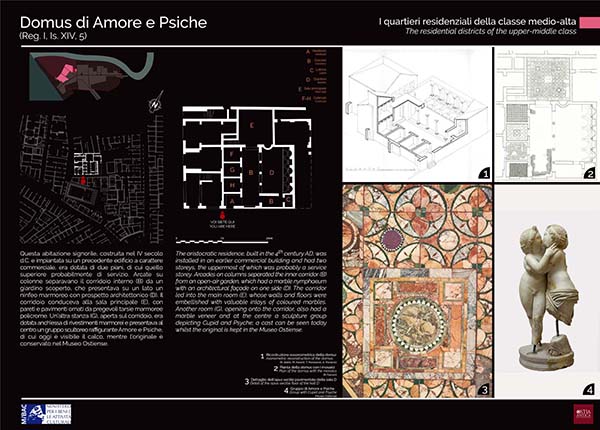
The aristocratic residence, built in the 4th century AD, was installed in an earlier commercial building and had two storeys, the uppermost of which was probably a service storey. Arcades on columns separated the inner corridor (B) from an open-air garden, which had a marble nymphaeum with an...
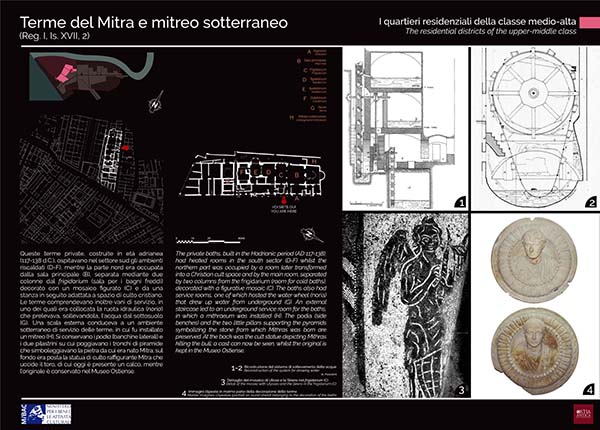
The private baths, built in the Hadrianic period (AD 117-138), had heated rooms in the south sector (D-F) whilst the northern part was occupied by a room later transformed into a Christian cult space and by the main room, separated by two columns from the frigidarium (room for cold...
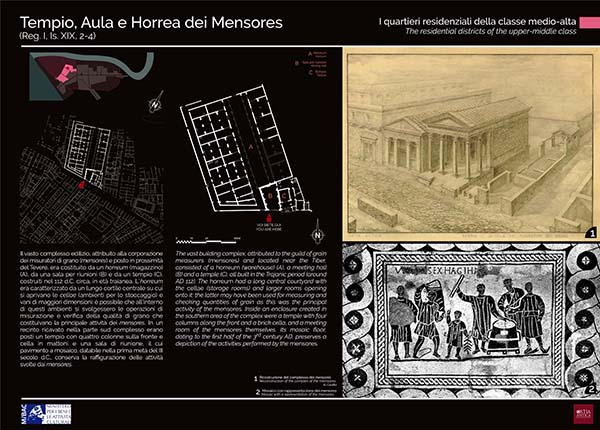
The vast building complex, attributed to the guild of grain measurers (mensores) and located near the Tiber, consisted of a horreum (warehouse) (A), a meeting hall (B) and a temple (C), all built in the Trajanic period (around AD 112). The horreum had a long central...